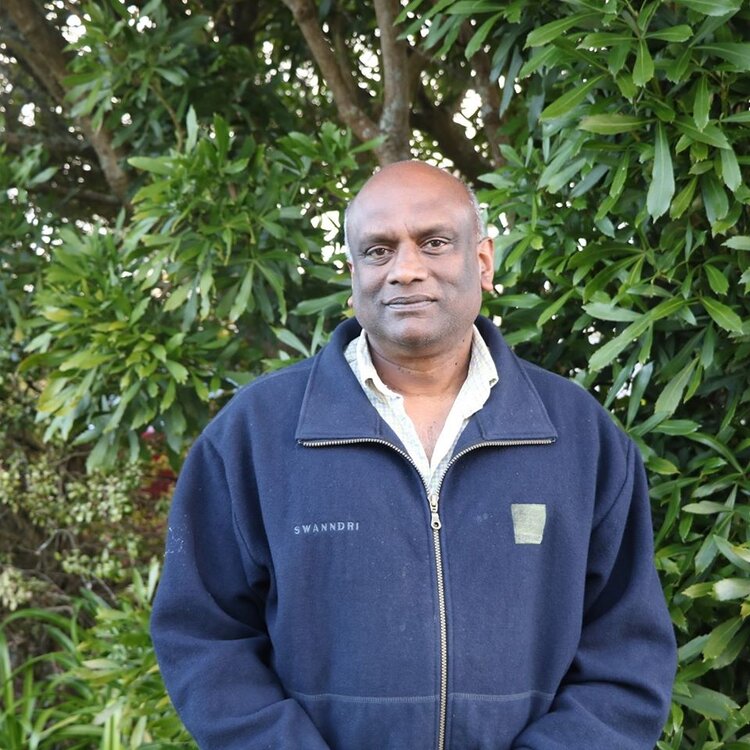
Gordon Rajendram the soil scientist

Phillip

The Road to Healthy Profits

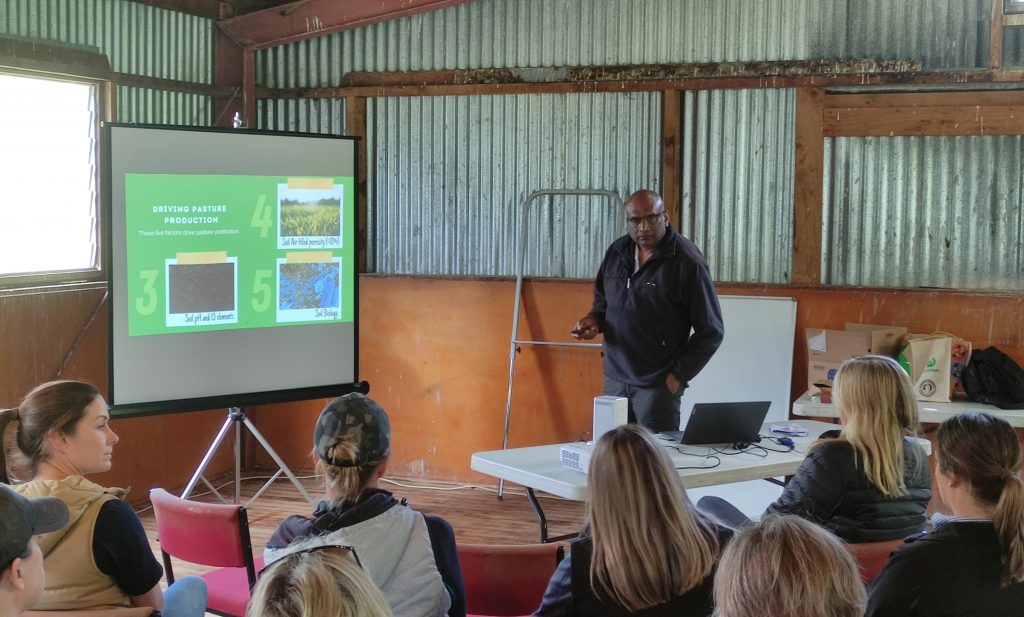
Written by Sean Toohey Healthy Animals Means Healthy Profits We recently had the pleasure of participating in the Wairarapa Rural Women’s Initiative Discussion Group.  The theme of the October meeting was better farm management through alternative fertiliser options. The event was held in the woolshed at our very own Jeane Fowler’s sheep and beef farm in Alfredton. A group of twenty or so farming ladies and a few farming fellas got together to hear from two industry experts on practical considerations when considering a move to alternative, environmentally friendly and financially sustainable practices to run a productive, profitable farming operation.  That’s quite a mouthful but that is exactly what the session was all about. Joining us on the day were Gordon Rajendram, a Waikato-based soil scientist who helps New Zealand farmers make better fertiliser decisions, and Raymond Burr, ex-dairy farmer and owner of independent testing lab Qlabs in Waipawa. Gordon and Ray both tackle the opportunity to change from a dollars and cents perspective. A view they hold in common is that farming profitability starts with healthy soil to generate nutritious plants that provide a healthy well-balanced feed for the animals.  It is more than just a consideration of cost of inputs vs outputs, there are many benefits to starting with what’s in the soil that deliver direct to the bottom-line of a farm’s profitability. Ray and Donna’s Journey Ray and Donna Burr converted their sheep and beef farm in King Country to a dairy platform back in 1990, milking 520 cows back when the average cow herd was 125 cows. They were quite innovative in what they were doing until the wheels fell off.  Too much nitrogen, too much phosphate and too many health issues with the cows. After receiving little useful information from some of the top scientists in New Zealand and consulting a laboratory that could not offer independent advice, Ray sought out a niche laboratory in Hawkes Bay which was able to offer him analysis and advice across the full 13 elements.  Ray says “The animal health turn around on the farm was simply amazing. After 3 years: no CIDRs, no inductions, no downer cows, a ten-week mating period, eight-week calving period and a vet visit once per year.” Increased milk solids per cow and some very healthy improvements to the bottom-line of the farm. Raymond Burr, Qlabs ”The animal health turn around on the farm was simply amazing. After 3 years: no CIDRs, no inductions, no downer cows, a ten-week mating period, eight-week calving period and a vet visit once per year. Raymond BurrOwner, Qlabs and ex-Dairy Farmer Ray, Donna and one herd manager ran the 520 dairy cows and around 250 young stock.  The three of them did all their own crops, regrassing and fertiliser applications.  Nitrogen use went down to 15 kilograms of urea per hectare for one third of the farm in the first rotation.  As Ray says “I don’t think we needed it, but hey it was a feel good factor”. The laboratory Ray sought out in 2000 was Quantum Laboratories, the New Zealand arm of a US operation.  Ray and Donna bought the business outright in 2016 and run the renamed QLabs as an independent, family-owned laboratory that is focused on animal performance starting with the soil and the plant.  Today from its beginnings as Quantum Laboratories, QLabs has been in operation for 45 years.  QLabs recently patented RNJE – urinary nitrogen evaluation from testing pastures which offers farmers a pragmatic measure to assess how to moderate N losses and nitrous oxide volatilisation. Show Me The Money As Ray says “It’s all about soil health, plant health and animal health. And at the end of the day, it’s the animals and their produce that fund the whole operation. Kilograms of dry matter? Anybody can grow kilograms of dry matter, just add urea. But that is not animal performance. We soil test for all 13 elements in the lab and we won’t make a fertiliser recommendation, unless we’ve tested for all of them because something small might be the limiting factor.” The Bottom Line? On their King Country dairy farm, they achieved a cash flow turnaround of approximately $250,000 per annum within 3 years – milk pay out adjusted.  Ray took the group through an interactive whiteboard session to demonstrate the operational and cash flow benefits of improved animal health across a farming platform. It was very much “dollars and sense” discussion and, yes, it starts in the soil. Soil Scientist Gordon Rajendram Dr Gordon Rajendram (PhD) is a Waikato-based soil scientist.  With more than 35 years’ experience in analytical testing, applied research including 22 years at AgResearch in Ruakura, Gordon now provides independent advice to farmers and fertiliser companies around New Zealand. Gordon Rajendram, Soil Scientist ”Soil testing allows farmers to make the best and most informed, data-based decisions for their farm, resulting in healthier land and stock as well as making a difference to your bottom-line Gordon RajendramSoil Scientist Gordon started by touching on the five universal factors in the soil that drive pasture growth: soil temperature above 5 or 6 degrees celcius (at 10cm depth), soil moisture above 25%, soil pH (ideal pH range 6.2-6.5) and 13 nutrients, good structure and porosity for air flow and good soil biology.  These are like the soil hygiene factors for good pasture growth. Testing 1,2,3 Gordon’s non-negotiable is that soil, pasture and animal blood tests are key if farmers want to get the most out of their fertiliser applications.  Soil and herbage tests will provide farmers with accurate data about the mineral imbalances that may be affecting the health of their crops or livestock. For Gordon, the devil is always in the data details. He advises “Soil testing allows farmers to make the best and most informed, data-based decisions for their farm, resulting in healthier land and stock as well as making a difference to your bottom-line”. His recommendation is to develop fertiliser programmes specific to different areas on your


The Road to Healthy Profits Read More »

The importance of independent soil advice

    The fertiliser industry is one of several large service industries that form an important role within the New Zealand economy. Could there be an increasing demand for independent advisers from farmers looking to ensure their best options for soil fertility? I recently did a presentation on soil fertility, soil nutrients and their fate to the Wairarapa Rural Women’s Initiative Group in Alfredton. Although the group are still relatively early in their journey toward alternative inputs, the presentation provided valuable information moving forward The presentation raised points outlining the importance of soil input, plant, animal and soil health:  

The importance of independent soil advice Read More »

Series 1; The Importance of Soil Aeration ‘Down Under’.

Soil porosity is a measure of air space in the soil and macroporosity is a measure of the proportion of large pores in the soil that provide air supply to roots and microbes. Soils that have been compacted because of animal treading or machinery have poor macroporosity levels. This is like a foot on an individual’s throat, and they are saying they can’t breathe. It’s the same scenario for plants and microbes. Ag Research soil scientist Dr Peter Singleton and his team based at Ruakura Research centre, Hamilton, in the late 1990s found that a 10% macroporosity level in soils was a critical value in relation to pasture and crop production. It’s a useful soil physical field calibrated test developed for New Zealand soils. His research team found that there was a 10 % decrease in pasture production for every 1% decrease in macroporosity below the critical level of 10 %. Depending on the soil type, treading and compaction damage can reduce pasture production by up to 50% or more and take 6 months to 1 year to return to normal pasture production levels. When soil structure is damaged, the infiltration rate decreases and pores that are required for aeration and drainage are destroyed. Other issues include ~80% decrease in worm populations, increased runoff of water, sediment and faecal coliforms, reduction of phosphate and other nutrient uptake and increased greenhouse gases. It can also affect soil temperature and plant root penetration. An excellent illustration of compaction and soil aeration was evident on a sheep and beef farm I visited near Te Kuiti. In a 30 meter by several hundred-meter strip in a paddock upon a hill, there was amazing pasture growth. This patch had approximately 2500 pasture cover but on either side of the 30 meter strip the cover would have been less than halve. The difference was obvious. The reason for the extra pasture growth was that a trench had been dug for a water pipe and when the soil had been returned it was in a less compacted state. As another example, I advised a young dairy farmer near Putaruru to aerate his paddock with a James aerator. The soil type was volcanic silt loam. He said the difference after aerating the paddock was incredible as the pasture growth difference to the next paddock where he did not aerate was phenomenal. There are many ways you can aerate a soil. You can do it chemically by using lime or gypsum, biologically by adding compost/organic matter, encouraging earthworms (by liming), and microbes & fungi or mechanically with a tractor and equipment such as a James aerator, ground hog, Rata and numerous other brands’ including a Forbes soil conditioner. Having drains can also reduce compaction by draining soils in wet periods of the year which will reduce compaction. About 2 months ago I was introduced to Stu Forbes by a mutual friend. Stu had developed his Forbes soil conditioner/aerator over a 35-year period with a team, including Prof. John Baker. Stu reckons he has got the best piece of equipment to aerate soils with. But he is always challenged by ‘show me the data’. That’s where I come in, as I see soil aeration/soil structure to be just as important, as soil moisture (by rainfall or irrigation) and soil pH and nutrients. Stu and I have therefore commenced trials on sheep/beef and dairy farms using the Forbes soil conditioner. The trial will be carried out on many farms around New Zealand, from as far north as Northland to Wairarapa, and in Canterbury. Pasture production will be monitored with and without the use of the soil conditioner.

Series 1; The Importance of Soil Aeration ‘Down Under’. Read More »

There is a lot going on below ground, says Hamilton-based Soil Scientist Dr Gordon Rajendram

The leaching of nutrients in soils generally occurs between the months of April – October, and there is a lot going on below ground, more than we imagine. This article explores the effect of rate of nitrogen fertiliser on cation and anion leaching under intensively grazed dairy pasture which can have far reaching effects on the way we farm from Hamilton-based Soil Scientist Dr Gordon Rajendram (PhD). In New Zealand, there have been limited studies on the topic of leaching of anions and cations in intensive New Zealand dairy farming systems. However, it is an important topic, as it is vital to the soil health and long-term effects on New Zealand farms. Leaching is the loss of water-soluble plant nutrients from the soil, due to rain and irrigation. Plant essential nutrients exist as anions and cations. Anions are elements or molecules that in their natural state have a negative (-) charge. Cations are ones that have a positive (+) charge in their natural state. Generally, soil is negatively charged and repels negative ions (anions), which are easily leached by rainwater and irrigation drainage.  Negative ions which are leached take a positive ion with it, it is part of nature. “The leaching of anions and cations is conditional on various factors including the amounts and form of nutrients applied in fertiliser, stocking rate, rainfall & therefore drainage, soil type and extent of previous leaching,” says the Soil Scientist Dr Gordon Rajendram The increased use of nitrogen fertiliser on dairy farms for the last few decades, has led to the growing concern about the effect on nitrate leaching to groundwater. A study in the mid 1990’s by Rajendram and Stewart Ledgard and other research’s at AgResearch set out to determine the amounts of Ca, Mg, Na, K, nitrate-N, sulphate-S, Cl and inorganic P leached from intensively grazed dairy pasture at three sites (Waikato, Taranaki & Southland) over a five-year period in the absence of N. In addition, nutrient leaching was determined in dairy farmlets at the three sites receiving 0, 200 or 400 kg N/ha/year. “The quantities of cations and anions leached from the farmlets getting no nitrogen fertiliser represented a significant removal of these nutrients from the system, particularly under high drainage,” comments Gordon. Where no N was applied, approximately $240 of fertiliser was applied above ground, but $160 of nutrients was lost below the root zone in drainage. Once the N applied was increased to 400 kg N/ha/yr, the value of nutrients lost below the root zone jumped to $250/ha/year. Another negative impact was, clover N fixation decreased from 180 to 0 kg/N/year when nitrogen application rates increased from zero N applied to 400 kg N applied per hectare per year. Leaching losses for cations and anions were similar between the different non-N-fertilised farmlets even though there were differences in soil drainage characteristics, region and management practices. This study showed that high-level leaching losses of Ca, Mg, Na, nitrate-N, sulphate-S and Cl occurred from intensively grazed pasture and that heightened farming intensity, through the use of N fertiliser, increased the losses of Ca and nitrate-N. Soil Magnesium levels were decreasing on farms in the 1980’s and 90’s. This study showed the reason why this was the case.  Approximately 30 kg per hectare of magnesium was being leached every year and not replaced in fertiliser or via rainfall. “These results have significant consequences to the sustainability of these systems, the potential for an increase in the incidence of hypocalcaemia and hypomagnesaemia in animals, and the requirements for nutrient inputs in fertilisers,” advises Gordon.  The research findings were included into the Overseer nutrient model. When farmers are required to determine their N leaching index, cations and anions leached is also generated by Overseer as part of the output. Waikato based Soil Scientist Gordon Rajendram is committed to helping New Zealand farmers get the most out of their soil so that their farm can work more proficiently, be sustainable while increasing farm profitability. Gordon is one of the leading voices in soil fertility.

There is a lot going on below ground, says Hamilton-based Soil Scientist Dr Gordon Rajendram Read More »

Soil chemical and physical testing removes the guesswork out of farming says New Zealand’s leading expert in soil fertility, Hamilton-based Soil Scientist Dr Gordon Rajendram (PhD). 

Waikato-based Soil Scientist Gordon Rajendram PhD is considered one of New Zealand’s experts in soil fertility. He is committed to helping New Zealand farmers get the most out of their soil so that their farm can work more proficiently, be sustainable while still increasing the farm profitability. Dr. Gordon Rajendram worked at AgResearch, Ruakura Research Centre, Hamilton.  He has developed two field calibrated soil tests (N & S) which are used for agronomic advice in NZ and his work on leaching has been included in the Overseer nutrient model. Soils will continue to change over time, that’s why regular soil testing is crucial to the continued health and success of your farm says Hamilton-based leading Soil Scientist Dr Gordon Rajendram (PhD). Soil testing will showcase the mineral imbalances that may be affecting the health of your crops or livestock. Macroporosity is a measure of the proportion of large pores in the soil that provide the air supply to roots and microbes. A 10 % decrease in pasture production for every 1% decrease in microporosity below the critical level of 10 %. It’s the best soil physical field calibrated test for New Zealand and was developed by AgResearch in the late 1990’s.   Treading damage can cost loss in pasture production. “When soil structure is damaged the infiltration, rate decreases and pores that are required for aeration and drainage are destroyed,” says Gordon. Other issues are ~80% decrease in worm populations, Increased runoff of water, sediment, faecal coliforms, phosphate and other nutrients plus Increased greenhouse gases. An ASC test (Anion Storage Capacity), previously known as P Retention, is a measure used to define the phosphorus (P) immobilisation potential of a soil. This will test the ability of the soil to hold on to phosphate and sulphur.   An ASC test must be included with every sampled area to determine its level. “This is particularly valuable information when bearing in mind the use of phosphorus and sulphur fertilisers,” adds Gordon.  Low ASC soils have minimal P binding sites. Once you have all the testing done, and have all the accurate information on what needs to go on your soil, the next step is to develop a fertiliser programme specific to each area or paddock. Fine particle or slow-release fertiliser is a great choice. Fine particle fertiliser has improved fertiliser use efficiency with lower spread rates required to get the most out of it. “Featuring a rapid uptake of needed nutrients, with fine particle fertiliser deficiencies can be rectified quickly due to the excellent foliar nutrient uptake,” adds Gordon. With efficient application the proportion of nutrients can be varied. Not only that, it also has reduced environmental impact. You may not be able to change your soil type or the climate, but you can control the amount and type of phosphorus and sulphur that are applied to vulnerable areas. If you want to discover more about the benefits of soil testing can bring to your farm, then make sure you get the best in New Zealand, the soil scientist Dr Gordon Rajendram out to your rural farm today.  With his BSc, MSc and a PhD, Gordon is one of the leading experts on laboratory and field measurement techniques for chemical, biological and physical properties. About The Soil Scientist Gordon is dedicated to helping all farmers get most out of their soil so that their farm can work more efficiently, be sustainable while improving the farm profitability. Contact Gordon: Email: rajendram@xtra.co.nz Phone: 021 466 077 Facebook: https://www.facebook.com/GordonRajendramSoilScientist Website: http://dev.gordonrajendramsoilscientist.co.nz LinkedIn: https://www.linkedin.com/company/the-soil-scientist Instagram: https://www.instagram.com/thesoilscientistnz/ Contact MediaPA: Phone: 0274 587 724 Email: phillip@mediapa.co.nz Website: www.mediapa.co.nz Facebook: www.facebook.com/MediaPA YouTube: www.youtube.com/user/TheMediaPA

Soil chemical and physical testing removes the guesswork out of farming says New Zealand’s leading expert in soil fertility, Hamilton-based Soil Scientist Dr Gordon Rajendram (PhD).  Read More »

Series 2: Liquid, Suspension or Granular Fertiliser, which is better?

Waikato-based Soil Scientist Gordon Rajendram PhD is considered one of New Zealand’s experts in soil fertility. He is committed to helping New Zealand farmers get the most out of their soil so that their farm can work more proficiently, be sustainable while still increasing the farm profitability. Dr Gordon Rajendram worked at AgResearch, Ruakura Research Centre, Hamilton.  He has developed two field calibrated soil tests (N & S) which are used for agronomic advice in NZ and his work on leaching has been included in the Overseer nutrient model. In this second article I further explore the above question, which is better liquid, suspension, or granular fertiliser? This year the farming industry has seen unprecedented price rises for two of the major nutrients required for pasture and crop growth, phosphate, and nitrogen. The price of phosphate has increased from $2.70 to $4.27 for a kilo of the nutrient, and likewise nitrogen has increased from $1.15 to $2.89. Other nutrients such as sulphur ($0.60 to $0.90 per kilo of S), potassium and trace elements have also increased appreciably.  Due to the increase in fertiliser costs farmers are faced with keeping pasture or crop production at similar or higher levels. They will look to solutions, methodology or technologies which will be more nutrient efficient. i.e., get more pasture response with less nutrient use.    In this article I will concentrate more on my experiences with technologies/methodology which may achieve the above goal.  In the 22 years I worked at MAF and its predecessor AgResearch, Ruakura Research Centre in Hamilton, the products we researched were generally all granular based.  We did Government funded research or did projects for companies who could afford us and there weren’t many of these companies in New Zealand.  In 2016 I gave a talk in the Far North, near Taipa, to a group of farmers. At question time one of the farmers sitting in the front asked me, what I thought of fine particle application (FPA)? FPA is a trade name, but I call it suspension technology. I told him I knew nothing about it.  After the talk I approached him and asked if I could visit his farm to see what he meant as I wanted to know more.  The farmer was Arthur Beazley who runs red devon cattle on a 120ha farm just north of Kaeo. I visited him the next day and he showed me his tow n fert machine. Therefore, this started me on my journey of learning about suspension technology and foliar/liquid fertilisers.  Suspension technology uses finely ground nutrients. There are companies in New Zealand who have specialised in this technology for more than 30 years. Companies such as Uptake,  based in Taupo owned by John Davis, Mainfert, based in Timaru owned by Marty Kimble and Dean White, and there are others as well who specialise in this technology in New Zealand. Suspension technology requires specialised ground-based equipment such as the tow n fert machine (Metalform in Dannevirke) or Cylone mixers (Chaos farming in Waihi). These machines require robust pumps and large nozzles. The ground up nutrients are very abrasive and therefore require specialised equipment. There are helicopter operators and SuperAir who have the equipment to apply it from the air.  Therefore 16 elements (or more), fine lime, including growth promotors, inhibitors, hard round seeds like clover, fungicides or insecticides can be applied together.  Suspensions are in between liquid and granular and are ground up nutrients, and rates of application of a nutrient per hectare can be as high as granular if required. So, how can these technologies be more efficient and cost-effective? These questions will be answered in the following series of articles.

Series 2: Liquid, Suspension or Granular Fertiliser, which is better? Read More »

Soil Scientist Gordon Rajendram (PhD)

Liquid, Suspension or Granular Fertiliser, which is better?

Waikato-based Soil Scientist Gordon Rajendram PhD is considered one of New Zealand’s experts in soil fertility. He is committed to helping New Zealand farmers get the most out of their soil so that their farm can work more proficiently and be sustainable while still increasing farm profitability. Dr Gordon Rajendram formerly worked at AgResearch, Ruakura Research Centre, Hamilton.  He has developed two fields of calibrated soil tests (N & S) which are used for agronomic advice in New Zealand and his industry-leading work on leaching has been included in the Overseer nutrient model. Due to the increase in fertiliser costs, farmers are faced with keeping pasture or crop production at similar or higher levels with similar fertiliser budgets to previously.  Can we, therefore, keep the same fertiliser spend as previously and grow just as much nutritious pasture or more pasture without compromising production or have any detrimental effects to the environment? This will be the first of a series of articles in which I explore the above question.  Firstly the main factors which drive pasture production are soil moisture, temperature, approximately 13 soil nutrients, soil acidity, microbiology and finally but not least soil air space (soil porosity).   The mantra I constantly use “if you don’t test, you cannot manage”.  It is very important to test soil, pasture, clover only and individual crops to see if any of the above factors are limiting growth.  All these parameters have optimum limits for pasture or crop growth and will be limited if these are not in the target areas. For the 13 nutrients,  once the optimum levels are reached, only maintenance rates are required and therefore application rates can be low depending on the nutrient, soil type and climatic factors (leaching and runoff).  Monitoring of pasture growth rates is also a very important testing tool. In the last five years, I have had experiences with technologies that I believe can be part of achieving the above. In this article, I will concentrate more on my experiences with these technologies whereas in the next articles I will dwell more on the science. The majority of fertilisers in New Zealand are applied in a solid granulated form for ease of spreading and generally are a in a highly soluble form i.e., becomes quickly available to pasture or crops. There are benefits to this but once optimum nutrient levels are achieved are there better technologies/modes of application available?  Suspension technology, or otherwise known as fine particle application or foliar/liquid,  may be more efficient and cost effective.  Soluble liquid fertilisers can be applied with normal spray equipment but with suspensions require specialised equipment with robust pumps and larger nozzles.   With liquids and suspensions up to 16 elements (13 for pasture growth plus three more for animal health) can be applied in one application, including growth promotors, inhibitors and fungicides or insecticides.  Suspensions are in between liquid and granular and are ground up fertilisers/nutrients and rate of application can be as high as granular if required. So, how can these technologies be more efficient and cost-effective? These questions will be answered in following articles.

Liquid, Suspension or Granular Fertiliser, which is better? Read More »

If You Can’t Test, Then You Can’t Manage, Says Waikato Soil Scientist

Slow-release products or “suspension fertiliser technology” is the future for pasture growth in New Zealand, according to soil scientist Dr Gordon Rajendram. While fencing or planting trees along waterways to reduce phosphate loss is an expensive exercise, Dr Rajendram says more affordable methods exist. “The cheapest way to reduce P [phosphate] is to change your product from a highly soluble one to a less soluble one,” he says in disclosing five factors that drive pasture growth. Five years ago, at a soil seminar, Dr Rajendram says an elderly farmer had revealed to him the suspension method’s ability to apply 16 nutrients in one application. This technology ticks many boxes not only for pasture growth, but environmentally. The Waikato-based independent fertiliser consultant outlines five factors that drive pasture growth: 1/. Soil temperature at 10cm is a good indicator. A drop down to 5 – 6 degrees C stunts growth. 2/. Falling below 25% of soil moisture content slows growth. 3/. The pH (acidity) level and 13 key elements are required for plant growth. 4/. Soil that isn’t porous robs roots and microbes of air. 5/. Soil biology When testing the soil, he says it’s imperative to avoid dung and urine hotspot patches that can skew readings because of high nutrient levels. Animals excrete 66% of what they eat. “If you can’t test, then you can’t manage.” In a pasture of rye grass and clover, the former contributing to 19% of the protein in pasture and the latter 34%, as clover is a nitrogen fixer. “So, that means the more clover you grow, the more [nitrogen] you’re fixing for free,” he explains. Dr Rajendram says clover’s digestible quality yields more energy, compared with grasses. With clovers and most grasses ‘allergic’ to soil acidity, farmers need to monitor soil pH content to acquire 6.2- 6.5 soil pH levels.  These soil pH levels are based on many factors with Irish farmers also recommended these ideal pH levels. Farmers must strike an “optimum” level to avoid low productivity but also not “overcook” to incur leaching costs. “In Waikato, you become a bit of a slave to phosphate but, in Canterbury, you have more potential to lose it,” Dr Rajendram reveals. “It’s hard-earned money you don’t want to lose.” April-to-October rain and drainage dictate the extent of leaching. Any nitrogen that plants fail to absorb drops incrementally by approximately a metre each year until it reaches aquifers and streams. Anions (negative ions), such as nitrate and sulphate, attract and hold cations (positive ions), such as calcium and magnesium, in aiding leaching. However, minute amounts of phosphate via runoff or leaching aren’t an economic issue, but an environmental one. Contact Gordon: Email: rajendram@xtra.co.nz Phone: 021 466 077 Facebook: https://www.facebook.com/GordonRajendramSoilScientist Contact MediaPA Phone: 0274 587 724 Email: phillip@mediapa.co.nz Website: www.mediapa.co.nz Facebook: www.facebook.com/MediaPA

If You Can’t Test, Then You Can’t Manage, Says Waikato Soil Scientist Read More »

Growing Good Dirt

When a young Gordon Rajendram took a casual summer job at Ruakura Research Centre, no-one involved had any inkling that he would go on to be a research trailblazer and a leading expert around soil fertility.  Although that summer job was undertaken while studying for his first degree at Waikato University – Ruakura Reserarch Centre went on to play a pivotal role in Gordon’s career and he ended up working at the prestigious Research Centre for 22 years. Now with BSc, MSc and a PhD to his name, Dr Gordon Rajendram is widely regarded as a pioneer in laboratory measurement techniques for chemical, biological and physical properties in materials (aka he specialises in soil fertility). He holds a number of patents (five to be exact) and along the way has been nominated by AgResearch for Kudos Awards: Scientist of the Year in 2008 for work done on the soil sulphur test and its agronomic advice. He was also nominated by Ministry of Science and Innovation for Kudos Awards: Science Entrepreneur of the Year in 2010 for his work done on precision farming. Continuous growth And now in the next phase of continued development, Gordon has recently launched his new website (gordonrajendramsoilscientist.co.nz): dedicated to helping farmers get the most out of their soil, and providing soil knowledge to help farms work more efficiently and sustainably, while improving profitability.  Specialising in independent soil advice, Gordon brings more than 35 years of experience in analytical testing development, applied research and consulting to farmers and fertiliser companies.  “This website has been a long time coming and I am excited to finally share it,” he says.  Information shared on the website also highlights the importance of getting soil tested and why this needs to be done regularly. “Soil testing can help you more effectively use plant nutrients and reduce the leaching or runoff into waterways,” says Gordon. Helping to demystify the science around soil, Gordon is driven to help farmers on their journey to getting an accurate read on what elements are needed in their soil.  “With increasing fertiliser costs, soil and pasture testing are key if farmers want to get the most out of their fertiliser. And the way to do this is through soil and pasture/herbage testing. “Soil and herbage testing give accurate data about the mineral imbalances that may be affecting the health of your crops or livestock. Soil testing allows you to make the best and most informed, data-based decisions for their farm, resulting in healthier land and stock as well as making a difference on your bottom line,” advises Gordon. After soil testing, a fertiliser programme can be developed specific to each paddock or area which will save money by determining the correct proportion of fertiliser to apply in each paddock or area. Spreading on too little fertiliser is just as wasteful as applying too much.” Early Days Having moved to New Zealand when he was nine years old, Gordon’s introduction to rural living came via time spent on the two farms at St Peter’s School in Cambridge, where his father taught.  “In fact, I pulled out ragwort on one of those farms when I was about nine years old – and got paid for it!” Following that early introduction to farm labour, Gordon went on to experience other elements of rural life, involved in haymaking and milking cows on a Taupiri farm before heading to university to pursue his studies.  Any time not dedicated to researching knowledge, was spent playing or watching a variety of sports, from rugby and league to cricket and tennis. Quiet achiever While Gordon has prolifically achieved throughout his career, his soil fertility research has by no means made him a household name, even though the impact of his research has been far reaching in farming, horticultural and fertiliser industries. Much of his work has been included in Overseer. Unfortunately, minimal government funding has drastically reduced research work being carried out, but Gordon continues his commitment to sharing his knowledge and insights.  A member of New Zealand Society of Soil Science and of New Zealand Grasslands Society, he has more than 70 publications to his name (mainly achieved while working at MAF and its predecessor AgResearch, Ruakura Research Centre in Hamilton). Among the many areas his research has impacted is his study into Soil Nitrogen (N) and Field Calibration. In 2008, he developed a field calibrated pastoral soil N test for New Zealand which would benefit NZ agriculture massively.  Revolving around the strategic use of N fertiliser on areas of farm based on the N status (Organic –N and the easily mineralised N fraction) of the soil; this IP was brought by Ballance Agri nutrients as part of an $18 Million funding deal with MSI and AgResearch. It was initially called ‘N Guru’ but has been renamed as ‘Pasture planner’.  Much of Gordon’s research and knowledge can be found on his website and Farm Trader welcomes him to its team of regular columnists also. 

Growing Good Dirt Read More »

Important factors for soil nutrient retention – New Zealand’s leading Independent Fertiliser Consultant Hamilton-based Soil Scientist Dr. Gordon Rajendram PhD.

Waikato-based Soil Scientist Gordon Rajendram PhD is considered one of New Zealand’s experts in soil fertility. He is committed to helping New Zealand farmers get the most out of their soil so that their farm can work more proficiently, be sustainable while still increasing farm profitability. Dr. Gordon Rajendram worked at AgResearch, Ruakura Research Centre, Hamilton.  He has developed two field calibrated soil tests (N & S) which are used for agronomic advice in NZ and his work on leaching has been included in the Overseer nutrient model. There are many aspects to consider for healthy soil and pasture production. The appropriate soil testing can help you get it correct says Hamilton-based Independent Fertiliser Consultant and Soil Scientist Dr Gordon Rajendram PhD. There are two key factors that drive pasture production. Firstly, there is soil temperature measured at 10 cm. At 5 or 6 degrees, pasture stops growing.  Second is soil moisture. With a soil moisture <25 % there can be significant impact on pasture production. ‘Using a Field Calibrated Soil Test will help the farmer identify if they are achieving maximum pasture production, low productivity or wasting money due to excessive use of a nutrient,” says Independent Fertiliser Consultant and Soil Scientist Dr. Gordon Rajendram PhD. In addition, pasture species struggle on low pH soils due to the increased Aluminium in the soil solution which retards root growth, resulting in less growth of herbage. New Zealand farmers are not applying lime particularly on hill country, so many soils are getting very acidic (< 5.5 pH), with soils getting down to as low as 5.0 pH. However, with right testing and planning there is room in every budget for both lime and fertiliser to reduce soil acidification.  Leaching is the loss of water-soluble plant nutrients from the soil, due to such factors such as rainfall and irrigation. “Amount of nutrient lost via subsurface flow is related to amount of rainfall and drainage,” says Gordon. Plant essential nutrients exist as anions and cations, and the leaching of these anions and cations is conditional on various factors including the amounts and form of nutrients applied in fertiliser, stocking rate, drainage, soil type and extent of previous leaching. Anion Storage Capacity (ASC) or Phosphate retention (P-retention) is a measure of the soil to remove P from soil solution.  “This is key test which is inherent of the soil type should be included with every sampled area to determine its level. This is exceptionally valuable information when bearing in mind the use of phosphorus and sulphur fertilisers,” adds Gordon. Research shows that 70% of sulphur applied in a soluble form is leached from NZ soils. Phosphate is a key element for plant growth. Any phosphate applied needs to stay in the soil and not runoff as particulate P or leach into subsoils. Much of the loss is related to the soil type, climate, Anion storage capacity, and overuse of soluble forms of P. Mitigating P losses < 40% ASC greater potential to lose P from soil Apply little bit often Important to use right product Apply slow-release P & S products Combo of water soluble/slow-release P & S is best it is important to remember that fertiliser itself is only one aspect of a productive fertiliser management system. “If you don’t test and do it properly you are doing a disservice to your business,” adds Gordon. Ensuring that it is applied at the right time, place and rate is equally important. About The Soil Scientist Gordon is a Independent Fertiliser Consultant and is dedicated to helping all farmers get most out of their soil so that their farm can work more efficiently, be sustainable while improving the farm profitability. Contact Gordon: Email: rajendram@xtra.co.nz Phone: 021 466 077 Facebook: https://www.facebook.com/GordonRajendramSoilScientist Website: http://dev.gordonrajendramsoilscientist.co.nz LinkedIn: https://www.linkedin.com/company/the-soil-scientist Instagram: https://www.instagram.com/thesoilscientistnz/ Contact MediaPA: Phone: 0274 587 724 Email: phillip@mediapa.co.nz Website: www.mediapa.co.nz Facebook: www.facebook.com/MediaPA YouTube: www.youtube.com/user/TheMediaPA

Important factors for soil nutrient retention – New Zealand’s leading Independent Fertiliser Consultant Hamilton-based Soil Scientist Dr. Gordon Rajendram PhD. Read More »

Scroll to Top